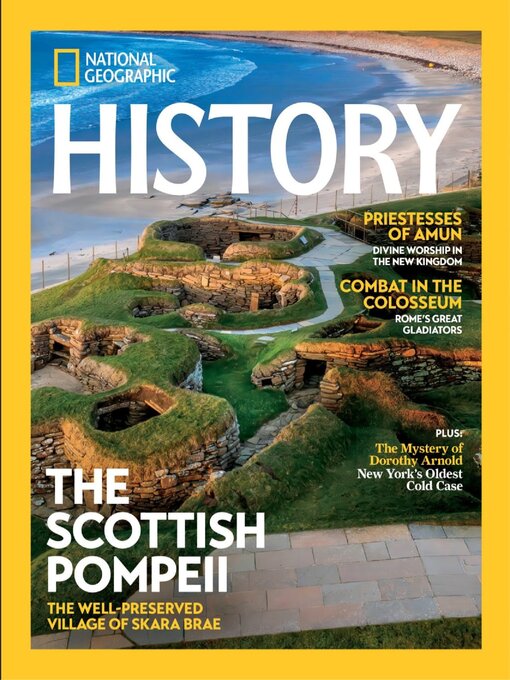
 November/December 2026
 September/October 2026
 July/August 2026
 May/June 2026
 March/April 2026
 January/February 2026
 November/December 2025
 September/October 2025
 July/August 2025
 May/June 2025
 March/April 2025
 January/February 2025
 November/December 2024
 September/October 2024
 July/August 2024
 May/June 2024
 March/April 2024
 January/February 2024
 November/December 2023
 September/October 2023
 July/August 2023
 May/June 2023
See how National Geographic History magazine inflames and quenches the curiosity of history buffs and informs and entertains anyone who appreciates that the truth indeed is stranger than fiction with a digital subscription today. And that history is not just about our forebears. It’s about us. It’s about you.
Gold at the End of the Rainbow • A detectorist in Leipzig, Germany, has discovered a rare Celtic coin.
FINAL KNOWN LOCATION
Dorothy Arnold: New York’s Oldest Cold Case? • The mysterious disappearance of the heiress, more than a century ago, remains a subject of fascination. Was she abducted or killed—or did she run away?
An Aspiring Writer With a Double Life
THE UNLIKELY LOVER
The Sicilian Expedition, Athens’s Big Mistake • Thucydides recounted the catastrophic Athenian campaign against the Sicilian city of Syracuse in dazzling style in a work of great objectivity for the fifth century B.C.
A FORCE TO BE RECKONED WITH
LIFESAVING VERSES
The Crystal Palace Captivates the World • The first world’s fair was held in England, inside a colossal building of iron and glass that pushed the boundaries of engineering and seemed to defy physics.
A Spectacle of Countless Marvels
CLASS DIVISIONS
The Crystal Palace Goes up in Flames
The Dodo Bird, an Icon of Extinction • This flightless bird, endemic to the island of Mauritius, died out within a century of the arrival of Dutch explorers. It has since become a byword for its own demise.
The Twisted History of Barbed Wire • Since the innovative first patent was registered by Joseph Glidden in 1874, barbed wire has proved useful in many circumstances—to keep in, and to keep out.
ALL CLEAR ON THE RAILWAY
FENCED IN
THE DEVIL’S ROPE IN TIMES OF WAR
SKARA BRAE THE NEOLITHIC POMPEII OF THE BRITISH ISLES • What did a Neolithic village look like? Magnificently preserved, the archaeological site of Skara Brae in Scotland’s Orkney Islands transports us like no other to the daily life of farming communities 5,000 years ago.
A NEOLITHIC ISLAND SETTLEMENT
A Bird’s-Eye View • The lack of readily available timber required ingenuity from the ancient settlers, who took advantage of natural walls and the heat of the earth to build their homes. This plan of the settlement was printed in the official guidebook to Skara Brae by the archaeologist V. Gordon Childe, published in 1950.
The Orkney Islands, a Major Neolithic Center
Ancient Tools, Craft, and Magic • The inhabitants of Skara Brae used their ingenuity and the materials available to them to craft objects that made their daily lives easier, as well as others that may have been related to a magical and symbolic world.
THE PRIESTESSES OF AMUN • During the New Kingdom, ceremonies at the Temple of Amun involved female singers, dancers, and acrobats, organized under the supervision of the God’s Wife of Amun.
ROYAL AND DIVINE WIVES
THE WIVES OF THE GOD AMUN
SONGS FOR AMUN • This relief from Queen Hatshepsut’s Red Chapel at Karnak depicts singers and dancers—both men and women—taking part in the major festivals held in Thebes in honor of the god Amun.
THE DIVINE ADORATRICE
SONGS FOR THE AFTERLIFE • Upon their deaths, the priestesses of Amun were regaled with splendid burials and funerary goods. It has been demonstrated that at least one singer, Sha-Amun-en-su, had her throat wrapped in resin bandages in order to preserve her voice beyond the grave.
GLADIA TORS COURAGE IN THE FACE OF DEATH IN ANCIENT ROME • The bravery and skill of these fighters drew thousands of spectators to amphitheaters across the Roman Empire.
DEATH IN THE ARENA
AMPHITHEATERS ACROSS THE EMPIRE
GLADIATOR SCHOOL •...